Nobody wakes up thinking, “Today I’ll finally research disposable lunch boxes.” You start looking because something went wrong. Maybe a customer sent a photo of a paper container that collapsed during delivery. Perhaps you noticed that faint plastic smell after microwaving last week’s test order. Or perhaps you just got tired of wiping oil from the bottom of bags and wondering if there’s a better way. Most packaging websites will tell you their boxes are “eco‑friendly” or “food‑safe.” The pictures all look the same. What they don’t tell you is the one thing you actually need to know: will this box still look, feel, and perform like a proper container when the food is piping hot, slightly greasy, and has been bouncing around in a delivery bag for 40 minutes? That’s the real test. And it’s the reason so many restaurants, caterers, and meal-prep businesses have started quietly moving their bulk orders toward sugarcane fiber.
TABLE OF CONTENTS
- 1. Plastic Worked—Until People Started Paying Closer Attention.
- 2. Paper Boxes Look Lovely—Then Hot Food Enters the Chat.
- 3. Why Sugarcane Fiber Solves the Problems That Actually Annoy People.
- 4. Don’t Forget the Lid..
- 5. So Which Lunch Box Should You Actually Choose?
- 6. Quick Questions Clients Ask Before Ordering.

Plastic Worked – Until People Started Paying Closer Attention
PP plastic containers were the default for years, and frankly, they still get the job done in a pinch. They’re cheap, they stack neatly, and nobody questions them on a cold sandwich platter.
But the world changed. Not because of a new law, but because customers started noticing small, unsettling things.A slight chemical taste when reheating. Condensation beads that feel greasy. The uneasy pause before putting a black plastic tray in the microwave. Most people can’t name the material or the science, but they register the feeling: “this doesn’t feel right.”That uneasy feeling has real business consequences. People stop ordering. They associate a flimsy, plastic-scented container with lower-quality food, even if the meal itself was excellent. And as search terms like plastic‑free food containers and compostable takeaway packaging keep climbing, one thing becomes clear: for a growing number of customers, plastic no longer feels like the safe default.
Paper Boxes Look Lovely — Then Hot Food Enters the Chat
Paper lunch boxes are photogenic. That warm kraft color, the soft texture – they look natural, healthy, and responsible before a single bite is taken.The trouble hides inside. Most paper food containers rely on a thin PLA lining derived from corn starch to stop oil and moisture from leaking. The word “plant‑based” sounds reassuring, and at room temperature, it does its job.But pour in a hot curry, a ladle of fried rice, or a steaming noodle soup, and everything changes. The lining can soften, the folded corners may start weeping oil, and the whole container can feel oddly fragile in your hands. Sometimes it holds – just barely – but the impression is already set: this packaging isn’t quite trustworthy.And once a customer has that doubt, they tend to remember it long after the meal is finished.
Why Sugarcane Fiber Solves the Problems That Actually Annoy People
Here’s what happens the first time someone picks up a sugarcane bagasse lunch box: they feel it, and they think “this is solid.” Not scientific. Not technical. Just a quick, subconscious judgment that the meal inside is being treated with respect.That moment matters immensely. Before anyone tastes the food, they’ve already judged the packaging with their hands. A sturdy, substantial container builds trust; a flimsy one sows doubt.Sugarcane fiber is made from the dry, pulpy material left behind after sugarcane stalks are crushed for juice – stuff that used to be thrown away. Pressed into shape under high heat, it naturally resists water and oil without needing a separate plastic coating. It handles temperatures well above boiling point, and in an industrial composting facility it breaks down in roughly 90 days.But for a busy kitchen, the real win is simpler: it doesn’t leak, it doesn’t go soggy, and it doesn’t make anyone hesitate before reheating their lunch.That’s why, when you browse through our sugarcane bagasse containers, you’ll see sizes and compartments built specifically for the way real food behaves — curries, stir‑fries, soups, meal prep boxes — not just for photos on a website.
Don’t Forget the Lid
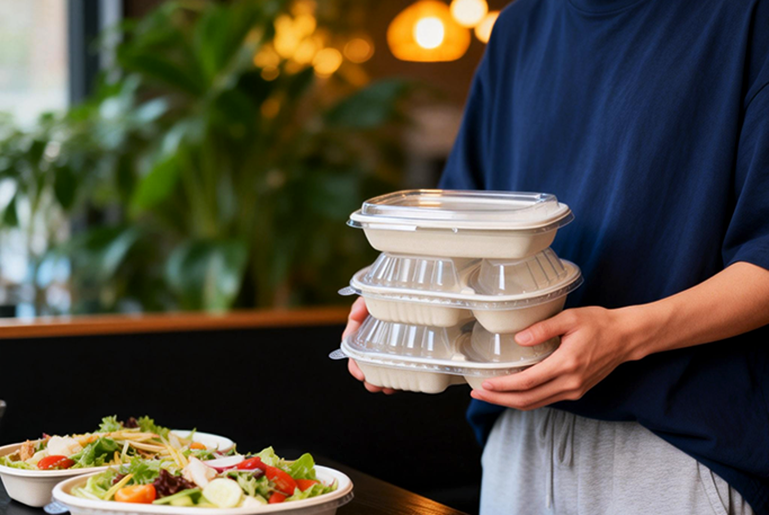
You’d be surprised how many carefully chosen compostable boxes end up with a standard plastic lid on top. The base says “earth‑friendly,” the lid says “500 years in a landfill.” Customers notice that mismatch faster than you’d think.A consistent package is far more powerful than a perfect one. If your box feels clean, sturdy, and honest, but the lid is flimsy and suspiciously glossy, the whole story crumbles. Not because your customers are packaging experts, but because humans are wired to spot inconsistency.That’s why we recommend pairing your sugarcane bases with CPLA lids — a crystallized, heat‑resistant version of PLA that composts under the same conditions as the container. It looks clear, it seals well, and it completes the circle. No mixed messages. Just packaging that feels like a single, coherent product.
So Which Lunch Box Should You Actually Choose?
There’s no holy grail, and anyone who insists otherwise is probably holding a brochure. Cold salads, sandwiches, and short‑distance deliveries can still work beautifully in paper or even plastic, especially when budgets are tight.But the moment you introduce heat, oil, microwave reheating, or longer delivery times into the equation, the performance gaps between materials widen fast. And in those scenarios — the messy, real‑world ones — sugarcane fiber separates itself not by being trendy, but by being stable when it counts.Your customers won’t remember the material spec. They’ll remember whether the meal arrived intact, felt warm and safe, and didn’t leave them wiping grease off their hands.That’s the bar. And clearing it is what keeps them coming back.
If you’re thinking about making the switch, here’s where most businesses start:
- Sugarcane Bagasse Lunch Boxes (650ml‑1000ml) – the workhorse for hot meals, curries, grain bowls, and anything that travels. Leakproof, microwave-safe, and freezer‑friendly.
- CPLA Transparent Lids – heat‑resistant, crystal clear, and fully compostable with the base. No more mismatched packaging guilt.
(Ask about custom sizing, multi‑compartment designs, and branded printing. We ship globally.)
Quick Questions Clients Ask Before Ordering
Can they really go in the microwave?
Absolutely. Unlike many coated paper containers that soften or plastics that make people nervous, bagasse holds its shape above 100°C with no hidden lining to worry about.
How long until they break down?
In an industrial composting facility, about 90 days. Home composting takes longer, but the material returns to the earth without leaving microplastics behind.
Do they handle oily food like curry or fried rice?
Yes – and this is where they really shine. The natural fiber resists grease and moisture all on its own, so the bottom stays firm and dry even with hot, high‑fat dishes.
What about the lid?
Use a CPLA lid to keep the entire package compostable. It withstands heat, provides clear visibility, and doesn’t contradict the promise your base makes.


