Walk into any modern coffee shop today and you'll notice a clear shift: customers expect more than good coffee—they expect responsibility.A few years ago, "going green" was mostly a branding choice for coffee shops.Today, it's becoming part of everyday operations.Customers notice the cup in their hand. Cities are introducing restrictions on single-use plastics. Large employers and universities increasingly prefer vendors that align with sustainability goals.Yet many café owners still hesitate when it comes to eco-friendly packaging for one simple reason:It feels expensive.Switching thousands of takeaway cups, lids, sleeves, and food containers each month can look like a significant cost increase on paper.But here's the overlooked truth: going green is not just a cost increase—it's a cost structure decision.
TABLE OF CONTEN
The Real Numbers Café Owners Need to See
Will Customers Actually Pay for Eco Packaging?
The Smart Strategy: "Bring Your Cup" That Actually Reduces Costs
What Happens After Use? The Composting Reality No One Talks About
A Purchasing Strategy That Helps Control CostsCompostable Cup + Lid Set Designed for Cafés
Sustainability That Actually Works in Real Business
Ready to Upgrade Your Coffee Packaging Solution?
The Real Numbers Café Owners Need to See
A traditional plastic cup might cost a few cents less than a compostable alternative. At first glance, the decision seems obvious. But packaging doesn't exist in isolation. Every takeaway cup also influences:
- Customer perception
- Brand reputation
- Regulatory compliance
- Future procurement risks
- Repeat business
A cup isn't just a container.It's one of the few branded touchpoints every customer physically interacts with.That's why the most successful cafés evaluate packaging as part of their overall customer experience
Comparing Common Coffee Cup Options
| Factor | Traditional Plastic Cups | Paper Cups + Plastic Lids | Compostable Cups (PLA/Plant Fiber) |
| Unit Cost | Lowest | Slightly higher than plastic | 15-30% higher upfront |
| Leak Resistance | Excellent | Good | Good (with proper design) |
| Regional Restrictions | Increasingly banned | Partially restricted | Growing government incentives |
| Customer Perception | Negative to neutral | Neutral | Strongly positive |
| Brand Value Impact | Minimal | Low | Significant differentiation |
| Long-Term Cost Risk | High (bans = forced switch) | Medium | Low (future-proof) |
Here's the nuance 90% of coffee shop owners miss: the "real cost" is not just packaging price—it's customer retention + brand positioning.
Will Customers Actually Pay for Eco Packaging?
The most persuasive evidence comes from what's actually happening on the ground. The New South Wales Environmental Protection Authority ran a Reusable Café Project, tracking real cafés making the shift. The results were striking.
| Morning Glory Café:turning a challenge into $140 weekly savings Morning Glory, a small beachside café, ran a three-week reusable cup challenge. The mechanics were simple: discount for BYO, a visible "cup library," and clear signage. The outcome? They saved 700 single-use cups and lids from landfill per week and reduced packaging costs by $140 weekly. Total savings across the trial—$420. That's not a tax. That's money back in the drawer. Cat & Cow Coffee:revenue from a single-use surcharge Cat & Cow took a different route. During COVID, they introduced a 50¢ single-use cup surcharge. But here's the detail that matters: the surcharge wasn't a profit center. They donated every cent to local environmental causes. The shift in customer perception was immediate. A fee that could have generated resentment instead generated pride—for both the café and its customers. Butterbox Café:small savings with big consistency Butterbox launched a mug library—a small rack of reusable cups customers could borrow and return. The result was modest but steady: **saving an average of 100 cups and lids from landfill each week, reducing packaging costs by $25 weekly**—or $1,300 annually.
|
 |
What's driving that? Three things.
First, regulatory pressure.Single-use plastic regulations are expanding. They're not hypothetical future risks—they're active constraints reshaping the competitive landscape. Second, shifting customer behavior. More and more people are actively searching for cafés that use compostable cups or offer reusable options. They're not just hoping you'll switch—they're looking for places that already have. Third, customer retention. Multiple studies cited in the EPA's Reusable Café Project highlight that cafés adopting reusable or compostable systems saw increased loyalty among existing customers and attracted a new, sustainability-minded audience.
The Smart Strategy: "Bring Your Cup" That Actually Reduces Costs
Here's something many café operators discover after making the switch:The fastest way to reduce packaging costs isn't buying cheaper packaging.It's using less packaging.Build a BYOC Program That Customers Actually Use.Many "Bring Your Own Cup" initiatives fail because they are treated as promotions.The successful ones are designed as habits.Instead of large discounts, cafés often see better participation with:
- Small but visible savings
- Clear signage at ordering points
- Loyalty rewards tied to reusable cup usage
- Staff reminders during peak periods
Over time, even modest participation can significantly reduce monthly packaging consumption.More importantly, it creates a customer community that actively supports the café's sustainability goals.

What Happens After Use? The Composting Reality No One Talks About
One of the most misunderstood aspects of compostable packaging is what happens after the bin lid closes.Compostable cups (PLA-based or plant fiber materials) are designed to break down under industrial composting conditions—think 58-60°C heat, controlled humidity, and specific microbial activity.But for café owners, the question isn't scientific—it's logistical: Can your packaging actually enter a composting stream?Forward-thinking cafés are beginning to address this challenge by:
- Partnering with local composting programs
- Working with commercial waste providers
- Adding clear disposal instructions
- Educating customers on compost vs. recycling
Sustainability becomes much more credible when businesses consider the entire lifecycle of the packaging—not just the purchase decision.
A Purchasing Strategy That Helps Control Costs
For growing cafés and multi-location coffee chains, sourcing often has a bigger impact on margins than material choice.Many operators focus heavily on reducing per-unit cost while overlooking procurement efficiency.Working directly with manufacturers can help:
- Improve pricing consistency
- Reduce intermediary markups
- Simplify inventory planning
- Maintain product compatibility across cups, lids, and sleeves
- Support custom branding at scale
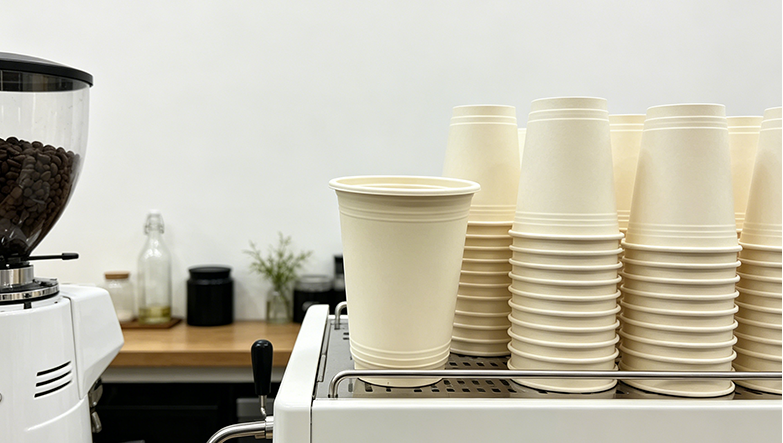
At MVI Eco Pack, our compostable cup systems are designed specifically for high-frequency café usage scenarios—covering both hot and cold drinks, with matching lids and sleeves to reduce compatibility issues in daily operations.The goal is not just "eco-friendly packaging," but economically sustainable packaging systems.
Compostable Cup + Lid Set Designed for Cafés
For cafés looking to switch without disrupting operations, here's a practical starting point:
 |
MVI Eco Pack Compostable Cup & Lid Set ✅ Tested for both hot (up to 95°C) & cold beverages |
Sustainability That Actually Works in Real Business
The most smart cafés don't treat sustainability as window dressing. They treat it as a system upgrade:
1. Smarter packaging choices that balance cost and customer perception
2. Behavioral nudges that make eco choices the default, not the exception
3. Better supplier structure that locks in long-term value
4. Clear end-of-life waste strategy that delivers on your environmental promise
Going green doesn't have to mean going expensive. In fact, when done correctly, it can improve both brand perception and operational efficiency at the same time.
Ready to Upgrade Your Coffee Packaging Solution?
At MVI Eco Pack, we work with cafés, coffee chains, roasters, and foodservice distributors to develop practical compostable packaging solutions for high-volume beverage service.Our compostable cup systems are designed to help operators balance:
Sustainability goals
Operational efficiency
Brand presentation
Cost control
Whether you're exploring eco-friendly coffee cups for the first time or scaling sustainability across multiple locations, our team can help identify a packaging solution that fits your business.
♦ Coffee Shop Exclusive Consultant – Click to inquire now
Designed for café owners who want sustainability without sacrificing margins.
|
Require a private label service for Your Zero Waste Business? Our professional eco-team offers consulting services to help you develop a comprehensive RENEWABLE packaging solution, including private label production for your business. Contact us to align your business with sustainable practices and achieve your zero-waste goals together. |
FAQ: Eco-Friendly Coffee Packaging in Practice
Q1: Is compostable packaging always pricier?
Not necessarily. When adopted as a system rather than isolated items, cost differences can be better managed over time.
Q2: Do customers notice packaging changes?
Yes, but often indirectly—through perceived quality and overall experience consistency.
Q3: Where do cafés usually begin?
Most start with takeaway cups due to their high visibility and usage frequency.
Q4: Is small-scale adoption effective?
Yes. Many successful transitions begin incrementally and scale naturally.