Driven by global plastic bans, rising environmental awareness, and corporate ESG transformation, the biodegradable disposable tableware industry has entered a rapid and sustainable development stage. With continuous material technological iteration and unified global certification standards, plant-based compostable tableware is gradually replacing traditional plastic products and becoming the mainstream choice for global catering and food service industries. This article analyzes the latest market size, growth drivers, technical trends, challenges and future development prospects of the industry from 2026 to 2035.
TABLE OF CONTEN
Market Size and Verified Growth Forecast
Core Market Growth Drivers
Material Innovation Improves Commercial Usability
Global Certification Standardization Reshapes Industry Threshold
Current Industry Challenges and Constraint
2026–2035 Industry Future Outlook
Market Size and Verified Growth Forecast
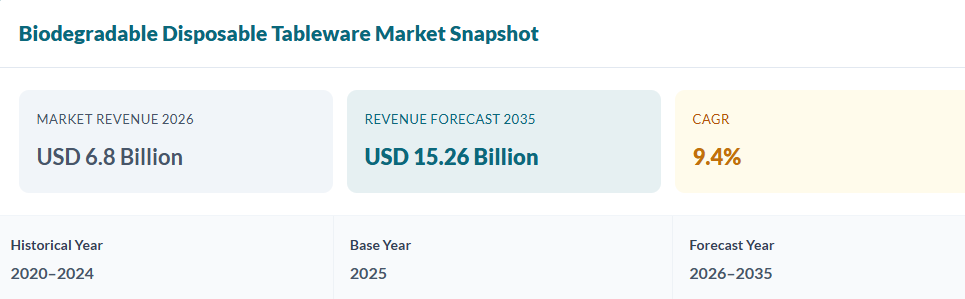
The global biodegradable disposable tableware sector is witnessing robust and structural growth amid worldwide plastic restriction policies and rising corporate sustainability demands. Based on 2026 global industry market analysis and decade-long forecasts, the market was valued at USD 6.8 Billion in 2026 and is projected to reach USD 15.26 Billion by 2035, growing at a 9.4% CAGR throughout the forecast period.
Core Market Growth Drivers
Regulatory compliance remains the most powerful driver for industry upgrading. Global mandatory bans on single-use plastics, covering the European Union, the United States and India, force quick-service restaurants, catering operators, airline catering services and institutional kitchens to phase out traditional plastic tableware and adopt certified compostable alternatives.
Consumer and commercial demand further accelerates market penetration. Rising public preference for plant-based, zero-toxic packaging boosts the adoption of biodegradable tableware in booming online food delivery scenarios. Meanwhile, increasing corporate ESG reporting standards push hospitality, education and medical institutions to replace disposable plastic products with eco-friendly tableware, forming stable large-scale B2B purchasing demand. The continuous improvement of municipal industrial composting systems in Europe and North America also eliminates critical end-of-life disposal barriers for commercial users.
Material Innovation Improves Commercial Usability
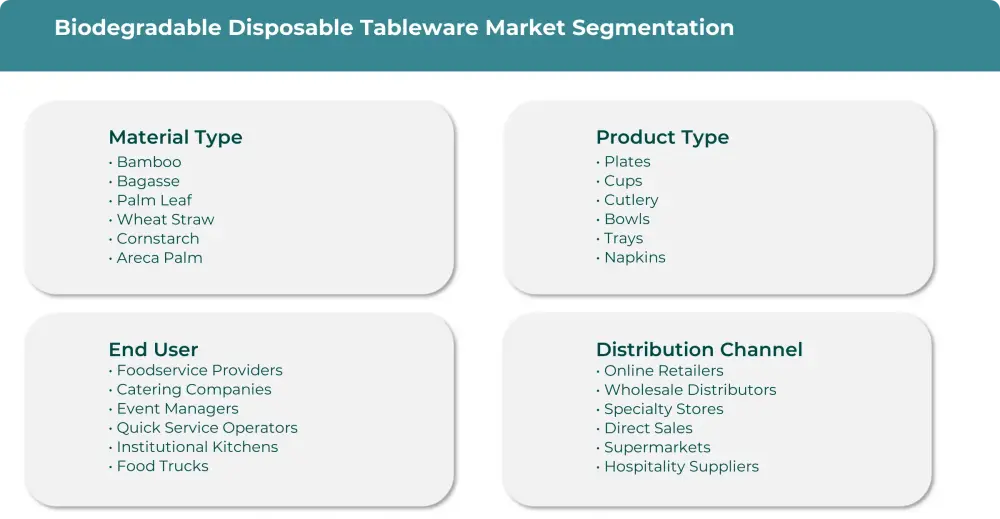
Historically, heat resistance and poor oil-water barrier performance limited the large-scale promotion of plant-based tableware. In recent years, continuous innovations in bagasse, PLA, bamboo fiber, wheat straw pulp and palm leaf materials have greatly narrowed the performance gap between biodegradable products and traditional plastic and foam tableware.
By optimizing biopolymer blending and adding cellulose nanofiber reinforcements, modern biodegradable tableware can stably withstand high temperatures above 90°C while maintaining reliable moisture and grease resistance. Technological upgrades enable eco-friendly tableware to fully adapt to high-standard commercial scenarios such as hot food takeaway, airline catering and institutional group meals. Among all materials, bagasse fiber maintains the dominant market share in European and North American commercial catering markets due to its stable supply chain and balanced cost-performance advantages.
Current Industry Challenges and Constraints
Despite promising growth prospects, the industry still faces tangible development constraints. At present, the production cost of qualified biodegradable tableware is still 30% to 50% higher than that of traditional plastic tableware, which restricts popularization in price-sensitive markets and small and medium-sized catering merchants.
In addition, the uneven quality of low-end products in the market affects overall industry credibility. The insufficient industrial composting infrastructure in Asia-Pacific, Latin America and other emerging regions also leads to the failure of many certified degradable products to achieve real environmental degradation effects, limiting local market willingness to replace plastic products.
2026–2035 Industry Future Outlook
In the next decade, biodegradable disposable tableware will transform from a policy-compliant alternative product to a mainstream standard for global catering procurement. Hybrid products with both compostable and recyclable attributes will become an important research and development direction, solving the promotion dilemma in regions with insufficient composting facilities.
Emerging markets represented by Southeast Asia and India will become core growth regions as local environmental policies tighten and supporting waste treatment infrastructure improves. Manufacturers with stable raw material supply, standardized certification qualifications and consistent product performance will continue to gain global B2B order advantages and market share increments.
|
Require a private label service for Your Zero Waste Business? Our professional eco-team offers consulting services to help you develop a comprehensive RENEWABLE packaging solution, including private label production for your business. Contact us to align your business with sustainable practices and achieve your zero-waste goals together. |
FAQ:
Q1:What is the global biodegradable tableware market growth trend?
The market grows steadily at a 9.4% CAGR, valued at USD 6.8 Billion in 2026 and projected to hit USD 15.26 Billion by 2035, driven by global plastic bans and ESG demands.
Q2:What fuels the growth of biodegradable tableware market?
Key drivers include global single-use plastic bans, booming food delivery demand, improved composting infrastructure, and corporate ESG procurement standards.
Q3: How does material innovation upgrade tableware performance?
Optimized bagasse, PLA and plant fiber formulas enhance heat resistance (over 90°C) and barrier performance, fully meeting commercial catering needs.
Q4: What certifications are required for cross-border sales?
EN 13432, ASTM D6400 and ISO 17088 certifications are essential market access thresholds for European and American markets.