


If you serve beverages, you have probably heard the complaint: “These compostable straws get soggy too fast.” But the problem is rarely the straw itself. More often, it is a mismatch between the straw material and the drink temperature.Different compostable materials behave very differently when exposed to heat or cold. Understanding those differences helps you choose the right straw for what you actually serve. This guide explains, based on material properties and available test data, how common compostable straws perform across real-world beverage temperatures.
TABLE OF CONTENTS
- 1.What Happens Inside a Straw When Temperature Changes
- 2.Paper Straws – Fine for Quick Cold Drinks, Not for Hot
- 3.PLA Straws – Optimized for Cold Drinks
- 4.PHA Straws – Heat‑Resistant and Reliable for Hot Drinks
- 5.Bamboo and Plant Fiber Straws – High Wet Strength from Natural Materials
- 6.Storage Conditions – An Overlooked Factor
- 7.Certifications That Actually Verify Compostability
- 8.Practical Selection Guide
.gif)
What Happens Inside a Straw When Temperature Changes
Traditional plastic straws are simple. They do not care much about heat or cold.But compostable straws come from plants — corn, sugarcane, bamboo, or paper fibers. These natural materials are designed to break down after use. That is good for the planet. But it also means they respond to temperature and moisture while you drink.When a compostable straw meets heat, three things can happen:
- The material absorbs moisture faster
- The structure becomes softer
- The surface may lose smoothness or rigidity
Cold drinks slow down these reactions. Hot drinks speed them up.That is why one straw does not fit every cup.
Paper Straws – Fine for Quick Cold Drinks, Not for Hot
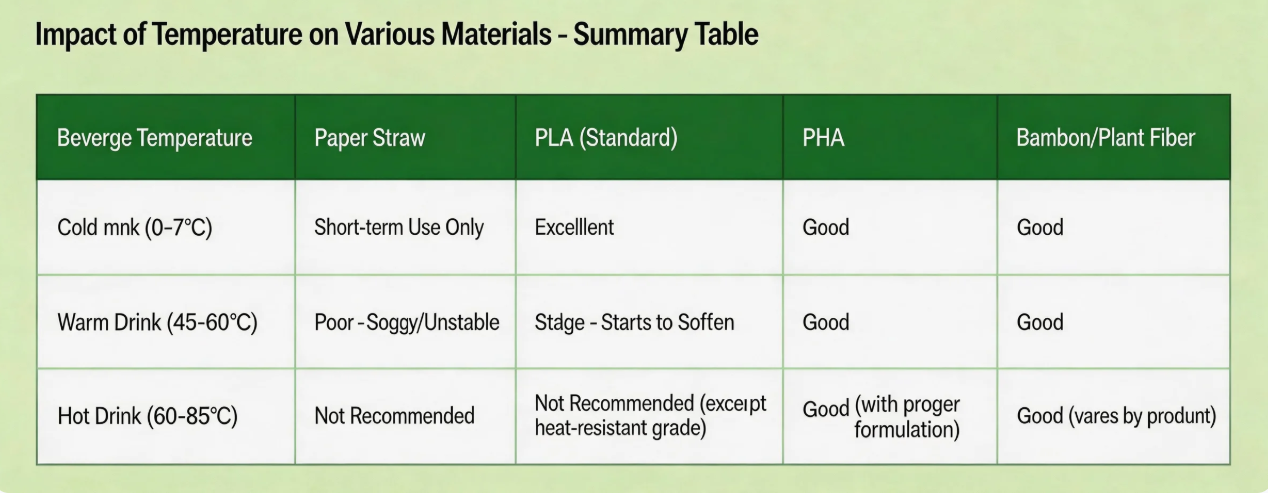
Paper straws are made from wood pulp with a moisture-resistant coating. In cold beverages (0–7°C / 32–45°F), they generally hold up for 15–30 minutes at a normal drinking pace. Beyond that, the submerged section begins to soften as water penetrates the paper fibers.In hot beverages (above 60°C / 140°F), the softening accelerates significantly. Heat increases moisture absorption and can weaken the adhesives used in the straw’s construction. For any drink served hot or expected to be consumed slowly, paper straws are not a reliable choice.
PLA Straws – Optimized for Cold Drinks
PLA (polylactic acid) is a bioplastic made from corn starch, sugarcane, or other plant sources. PLA straws are smooth, moisture‑resistant, and feel similar to conventional plastic.In cold drinks – iced coffee, smoothies, juice, bubble tea – PLA straws perform very well. They remain firm for the entire drinking duration, even with prolonged contact with liquid.The limitation of standard PLA is its heat tolerance. The glass transition temperature – where the material begins to soften – is around 55–60°C (130–140°F). Freshly brewed coffee or hot tea often exceeds 70°C (158°F), causing a PLA straw to lose rigidity within minutes. Some PLA blends incorporate PBAT or other modifiers to raise tolerance to about 70°C, but performance varies by manufacturer.PLA is excellent for cold beverages. For hot drinks, standard PLA is not recommended unless explicitly rated for high temperatures.
PHA Straws – Heat‑Resistant and Reliable for Hot Drinks
PHA (polyhydroxyalkanoate) is produced through bacterial fermentation of plant‑based oils or sugars. It is a newer generation of compostable biopolymer with very different thermal properties from PLA.PHA straws offer significantly higher heat resistance. Depending on the formulation, they maintain structural integrity at beverage temperatures above 70°C (158°F), with some grades tolerating up to 100–120°C (212–248°F) for short exposure. In practical terms, PHA straws work well in freshly brewed coffee and hot tea without premature softening.The trade‑offs are higher cost and less widespread availability compared to PLA. For operations that need a single compostable straw for both cold and hot drinks, PHA is a strong candidate.
Bamboo and Plant Fiber Straws – High Wet Strength from Natural Materials
Bamboo straws and other plant‑fiber straws are produced with minimal or no synthetic binders. Mechanical tests indicate that bamboo‑based straws absorb significantly less liquid than coated paper straws over time. In one comparative test, bamboo straws absorbed about 60% less moisture than paper after two hours in 80°C water, while maintaining much higher wet strength.These straws perform adequately across a wide temperature range, from cold smoothies to hot tea. However, consistency varies by manufacturer, and supply chains are less mature than those for paper or PLA. Buyers should verify product specifications before large‑scale adoption.
Storage Conditions – An Overlooked Factor
Compostable straws are designed to break down after disposal, not during storage. But improper storage can compromise performance before the straw ever touches a drink.PLA straws require climate‑controlled storage with humidity below 50% during warehousing. High heat or prolonged humidity can cause PLA to become brittle or begin degrading prematurely.Paper straws should be kept in dry environments away from direct moisture.PHA and bamboo straws are generally more stable but still benefit from cool, dry, and dark storage.Practical recommendation: Store all compostable straws in a cool, dry location, away from dishwashers, ovens, or direct sunlight. Use older inventory first.
Certifications That Actually Verify Compostability
Not every product labeled “compostable” meets a meaningful standard. Without third‑party verification, the term has limited legal weight.Under the FTC Green Guides, claiming a product is “compostable” without specifying the breakdown conditions can be misleading. Several states, including Washington and Minnesota, now require third‑party certification as legal proof of compostability claims.For compostable straws in the U.S. market, two certifications matter most:
ÜV Austria OK Compost HOME
This certification verifies that a product breaks down in ambient backyard compost conditions – without industrial heat or controlled aeration. It is the harder standard to meet, because decomposition must occur at lower, fluctuating temperatures typical of home compost bins. Products with this certification can be disposed of in residential composting systems.
BPI Commercial Compostability
BPI (Biodegradable Products Institute) certifies products that meet ASTM D6400 standards for industrial composting facilities. These facilities maintain temperatures of 58 ±2°C (approximately 136°F) with controlled humidity and aeration. BPI has certified over 51,000 compostable products to date and is the most widely recognized compostability certification in North America.Some products carry only one of these certifications. Others carry none, despite using terms like “biodegradable” or “plant‑based.” A smaller subset – including certain specialty straws – hold both certifications simultaneously. Dual certification is uncommon in the compostable straw category, but it offers a practical advantage: the same product can be composted in either a backyard bin or an industrial facility, depending on local waste infrastructure.When evaluating compostable straws for commercial use, checking for these certifications provides far more reliable information than reading claims on packaging alone.
Practical Selection Guide
No single compostable straw material performs optimally across the entire beverage temperature range. The effective approach is to match the material to your actual menu.
Cold‑only beverages (smoothies, iced coffee, juice, bubble tea): PLA straws offer the best balance of performance and cost.
Mixed temperature menu (cold and hot drinks): Consider PHA or bamboo fiber straws. The higher upfront cost may be justified by avoiding customer complaints.
Hot‑only beverages (coffee, hot tea): Use PHA or a heat‑resistant plant‑based straw. Paper straws are not suitable.
Short‑duration cold drinks : Paper straws remain functional, but they are not a universal solution.
Proper storage and verified certifications further ensure that the straws perform as intended. When a compostable straw fails during service, the problem is almost never “compostable products don’t work.” It is almost always a mismatch of material, temperature, or storage.
|
Need a Private Label Service for Your Zero Waste Business? Our professional eco-team offers consulting services to help you develop a comprehensive RNEWABLE packaging solution, including private label production for your business.Contact us to align your business with sustainable practices and achieve your zero-waste goals together. |
RELATE POST
GO PLASTIC-FREE WITH ECO PACK: WAYS STEP INTO A ZERO-PLASTIC LIVING
Molded Fiber Tableware: Why This Plastic Alternative Actually Works-MVI ECOPACK
Why Sustainable Bagasse Packaging Is the Future of Food Delivery Industry?


